The STL Trenches
Welcome to the ultimate resource for Trench Crusade players and hobbyists. Our community-driven repository
features a vast selection of 3D printable STL files, perfect for kitbashing unique warbands or finding the
ideal proxy models for your grimdark tabletop skirmishes. Whether you command the pious forces of
New Antioch,
the heretical legions of Hell,
or the mysterious Iron Sultanate,
you'll find high-quality miniatures to bring your battles to life. Explore our curated collection of free
and premium files from top
creators, optimized for resin printing and standard 32mm scale wargaming.
Looking for terrain? Terrain & Scenery
What are Trench Crusade Proxies?
What are the factions?
Are these official models?
How do I get the rules?
How do I use this site?
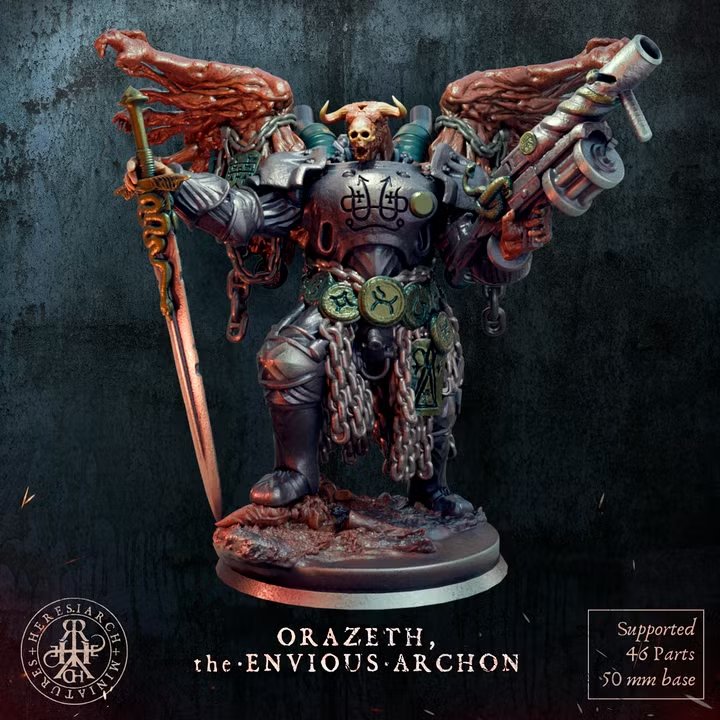
Räum, the Envious Archon

Triarii Heavy Weapons - Troopers of the Heresiarch
During particularly large and brutal offensives, entire battalions of Triarii may be formed, advancing behind the lines of Hastati and Princeps—securing positions, fortifying strongpoints, and annihilating the most resilient enemies in their path. More commonly, however, heavy weapon maniples are split apart and assigned as support to conventional Fusilier units or Assault Troopers. Heavy flamethrowers, machine guns, grenade launchers, and fearsome anti-tank rifles—Triarii possess the skill and discipline required to wield the most destructive tools on the battlefield.
Combined with their imposing presence and heavily reinforced armor, they significantly enhance the effectiveness of any formation they accompany. Their experience and authority bolster morale, assist Acolytes in maintaining discipline, and allow them to act as field officers during combat. In essence, for a capable commander, the proper deployment and management of Triarii is one of the most effective ways to stabilize and professionalize the army.
They also hold a key advantage: their instincts, honed through countless battles, allow them to judge when caution is required and when it is time to unleash the full fury of the Heresiarch.

Princeps Assault Troopers - Troopers of the Heresiarch
Shielded by steel plates reinforced with infernal protection sigils, they push through narrow galleries, clearing them with shotgun blasts, SMG fire, and assault grenades. Specialized maniples equipped with heavy shields and trench spears hold corners and chokepoints, forming tight, bristling defensive lines, while other Princeps—armed with lighter shields, short machetes, pistols, and grenades—move through the labyrinthine corridors, hunting down and exterminating any remaining resistance.
The equipment of a Princeps Assault Trooper is designed for durability. Their armor is reinforced with additional plating, greaves, and leather protection. Unlike lower-ranking Fusiliers, they are not expected to carry full campaign gear, as their role is focused entirely on decisive assaults and key offensives; they bear only their armor and personal arsenal.
To belong to this corps is a great honor. Servants and slaves are at their disposal, and the Princeps can be certain that—unlike lesser troops—their lives will not be squandered in expendable assaults by the War Clerics. The most exceptional among them, those who combine religious fervor with remarkable feats in battle, may rise to become one of the Heresiarch’s Chosen—the highest honor a soldier can attain.

Hastati Fussiliers - Troopers of the Heresiarch
The Hastati Fusiliers are neither precise marksmen nor skilled tacticians; it is their sheer numbers and their ability to absorb losses without breaking that allow them to hold ground and maintain constant pressure on the front. Their equipment is basic—crude armor, loosely standardized uniforms, sometimes little more than rags—and they carry most of their campaign gear on their backpacks. Their mobility is relatively high, as these masses of soldiers are constantly redeployed wherever they are needed.
In the eyes of the Heresiarch, their value does not lie in individuality, but in their function within the whole. They are the first to be sent into battle, tasked with absorbing the enemy’s initial strike. For many, serving as a Hastati is only the beginning, a test of faith and endurance that, if survived, may open the path to higher ranks within the Legion.

Velites Berserkers - Troopers of the Heresiarch
The Velites-Berserkers are made up of young, destitute recruits who cannot afford proper gear. They are issued only the most basic weapons. To survive, most resort to scavenged pelts and hides, along with lengths of chain stripped from destroyed vehicles. Gunpowder and firearms require industry and resources, which are not wasted on these outcast recruits; instead, they are given crude melee weapons of questionable quality. If a Velite carries a proper weapon or shield, it is almost certainly stolen. Most end up supplementing their arsenal with improvised tools, crudely modified for combat.
The Velites stand only one step above the Slaves and are tasked with similarly miserable duties: building and repairing fortifications, reinforcing low-priority positions, and preparing the ground for more capable regiments. Even so, fury has its uses. When the Veiled Priests need to storm a difficult position and seize new trench lines, they distribute hallucinogens and unholy incense among the Berserkers, inflame their rage, and unleash them like vermin in the first assault. The casualties are always horrific—few survive the machine guns—but once they reach close combat, their frenzy can deliver a bloody surprise to the enemy, buying time and distraction for the following waves of Fusiliers and Assault Troops to advance under relative safety.
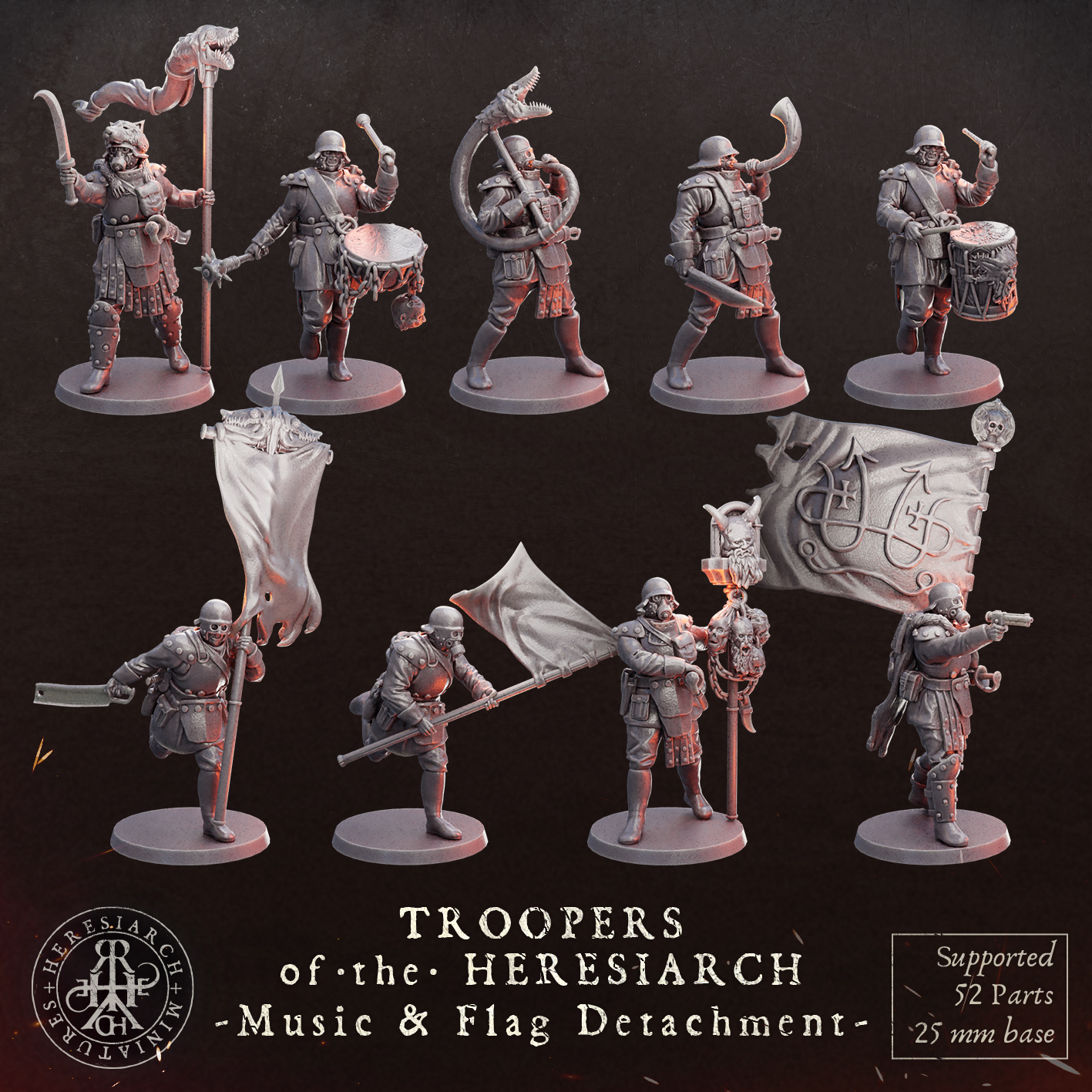
Music & Flag Detachment - Troopers of the Heresiarch
The Flags & Music Detachment is a chosen cadre within the Troopers themselves. These soldiers stand one step below the officer ranks, selected for their unwavering loyalty and ritual purity. Their task is to carry the will of the Legions directly into the storm of battle.
The drums mark the rhythm of the advance, the horns and cornua relay the orders of the Priests, and great kettledrums thunder warnings across the trenches. The standard-bearers guide the units through smoke and chaos, raising signals that can be recognized even amidst the bombardment. Serving in the Music & Flags Detachment is both an honor and a burden. They are expected to hold their position to the death, for if a standard falls or a signal is extinguished in the midst of battle, the failure is considered a stain upon the entire Legion — one the Heresiarch does not forgive without exemplary punishment.
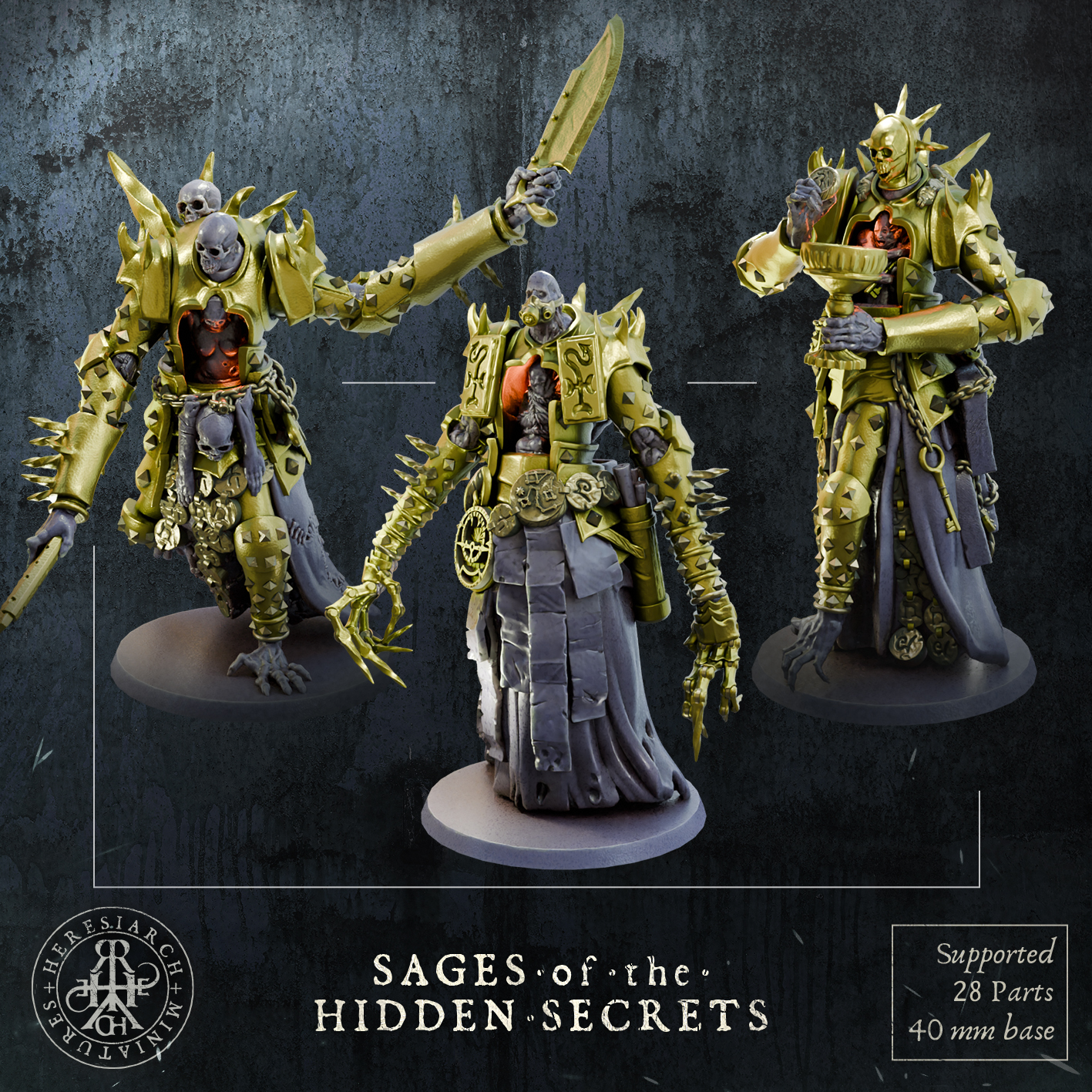
Sages of the Hidden Secrets
They were taught the mysteries of the stars and the hidden paths between them; alchemy and the transmutation of flesh; tablets of lost knowledge and forbidden geometries. Every secret of Goetia was offered to fuel their obsession, binding them irrevocably to Hell — both metaphorically and in the flesh. Their bodies were twisted by sorcery, organs fused to metal and blasphemous sigils, their souls sealed within goetic armor designed to contain their immense power in the mortal world and grant them a crude mockery of immortality.
Within their armored torsos lie the echoes of what they once were — a tormented core upon which their magic feeds, capable of tearing reality apart and reshaping it at the whim of their depraved minds.
Among the Legions of the Heresiarch, a blasphemous legend persists: that the first of the Sages were once three holy seekers, distorted reflections of the Wise Men of old. But where the Magi followed a star to kneel before Christ, these scholars turned instead toward a fallen star — a burning sign in the firmament that marked the cradle of the Heresiarch’s birth. There, they sought not salvation, but illumination without submission. The Lord of Greed rewarded their choice, and damned them for it in equal measure.
In the present age, the Sages walk the trenches wherever their impious master believes secrets or riches may be claimed. They are insatiable agents of his will. Their transformed bodies possess the strength to tear apart any soldier foolish enough to stand in their path, and their mastery of dark Goetia is sufficient to alter the course of entire battles.
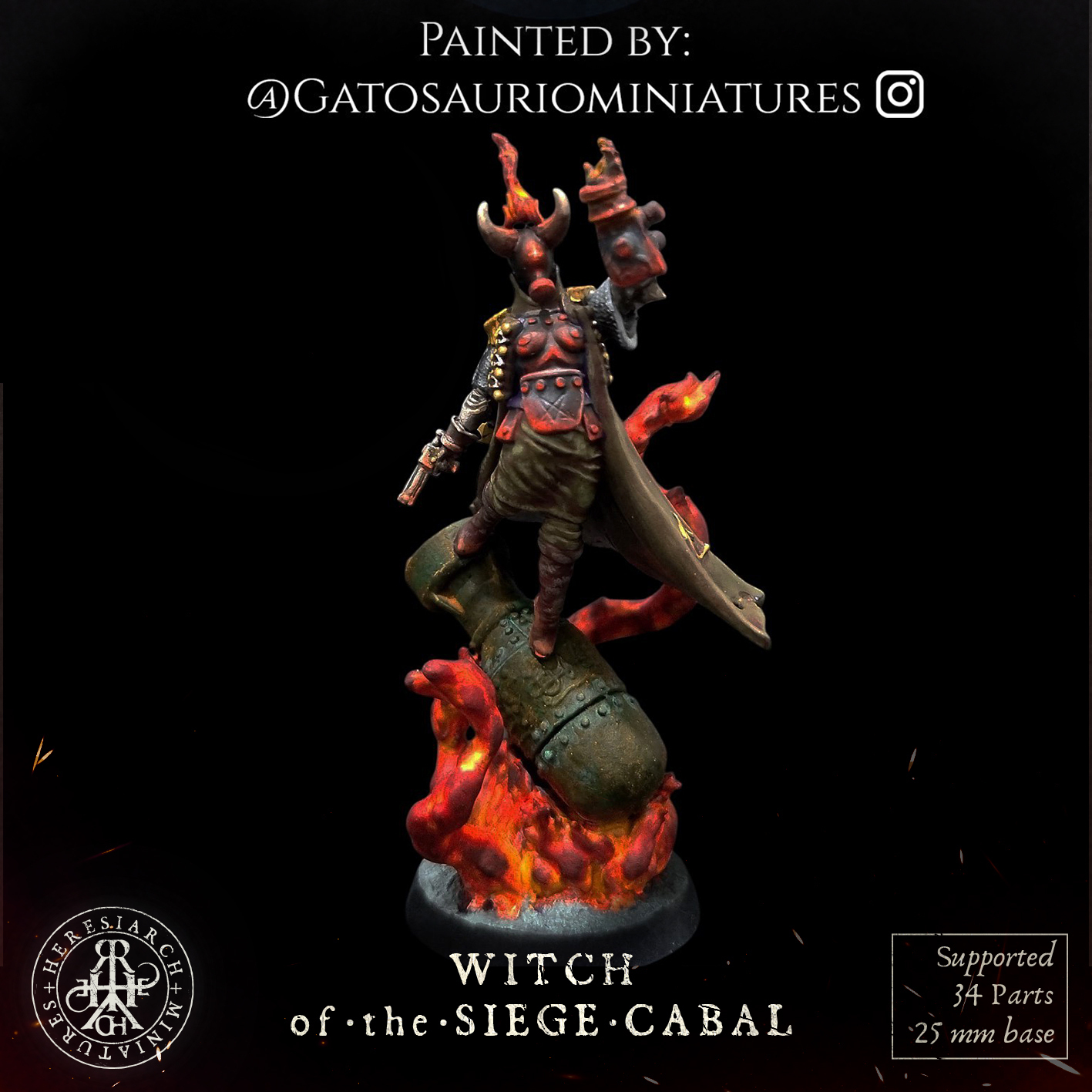
Witch of the Siege Cabal
No one truly knows how these two powers came together, nor the exact terms of the pact sealed between them. But two things are certain: the Witches of the Siege Cabal march alongside the Heresiarch’s Legions, raining fire and iron upon their enemies; and in return, every time the Heresiarch takes prisoners, one sixth of the captured women are delivered to the Cabal for their rituals. Always one exact sixth.
The numbers are never rounded. If that fraction amounts to “a dozen and a half” or “two fifths of a person,” the Taxing Matrons and the Heresiarch’s Veiled Priests take their measures, weigh, and make the necessary cut. After all, as one might expect, precision in calculation is vital within a sisterhood devoted to the arts of ballistics, goetic geometry, and the dark sciences of siegecraft and bombardment.
Everyone knows that the prisoners are tortured, twisted, and remade. Their minds are erased, and many claim their very souls are torn from their bodies. The witches thus created no longer speak; they need no eyes to see, nor mouths to communicate. When they fight, they do so with the cold precision of automatons, bodies of flesh and steel wrapped in clothes and armor, like perverse and lethal dolls. The rest of the time, they simply stand motionless, waiting until the Cabal, or the priests who command them, assign their next mission.
The only question that remains is what truly dwells within their bodies, and under whose power they move and respond.
Some believe the True Cabal are ancient beings, dwelling in secret temples, cursed by God never to walk the earth or see the sun—fighting their wars and exacting vengeance through these puppet vessels.
Others, more pessimistic still, claim that the witches are nothing but hollow shells of a soulless intelligence—born from impossible equations, intangible code woven from infernal spells and corrupted algorithms. As if the insidious demons that rule the forges of Hell had simply experimented to create something that replicates, destroys, and endures at all costs—existing only to offend the Creator, endlessly, without purpose or end

